Quick Guides
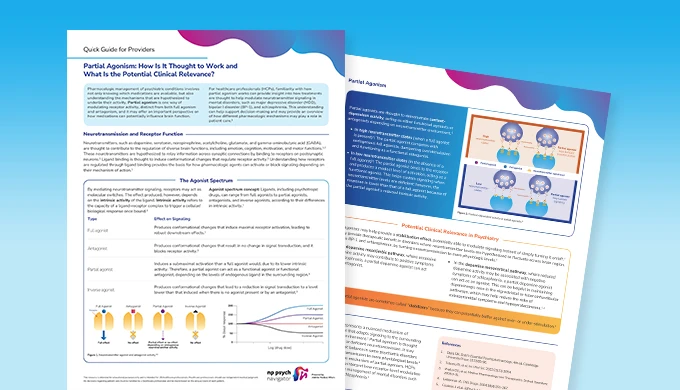
Partial Agonism: How Is It Thought to Work and What Is the Potential Clinical Relevance?
Understanding the neurotransmitter mechanisms thought to underlie the effects of medications used in treating mood disorders, including major depressive disorder (MDD), bipolar I disorder (BP-1), and schizophrenia, can help healthcare professionals make informed treatment decisions and manage patients’ symptoms.
Quick Guides
Common Scales in Major Depressive Disorder and Bipolar I Disorder
Standardized psychiatric rating scales help healthcare providers gather critical information to support accurate diagnosis and management of mental health conditions, such as major depressive disorder (MDD) and bipolar I disorder (BP-1). When used alongside clinical assessment and patient input, these tools can help monitor treatment response over time and guide clinical decisions as part of measurement-based care.
Quick Guides
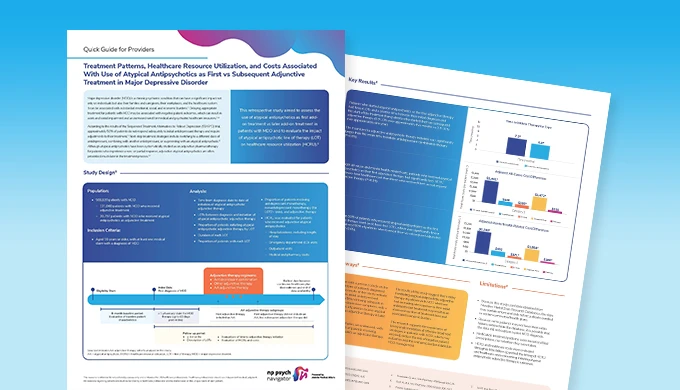
Treatment Patterns, Healthcare Resource Utilization, and Costs Associated With Use of Atypical Antipsychotics as First vs Subsequent Adjunctive Treatment in Major Depressive Disorder
Major depressive disorder (MDD) can be associated with substantial emotional, social, and economic burdens. Delaying appropriate treatment may contribute to negative outcomes and increased healthcare use. This quick guide highlights real-world data on the use of atypical antipsychotics as adjunctive therapy, with a focus on treatment patterns and healthcare resource impact in patients with MDD. These insights may help providers consider how treatment sequencing decisions could influence both patient care and system-level outcomes.
Quick Guides
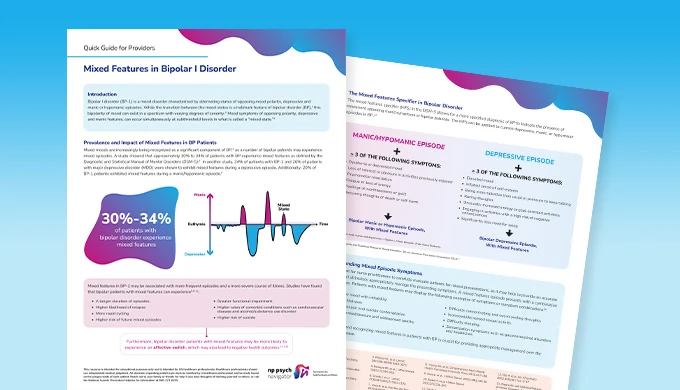
Mixed Features in Bipolar I Disorder
Many patients with bipolar I disorder (BP-1) can experience mixed features, which is the simultaneous occurrence of depressive and manic symptoms. Mixed features can be associated with negative outcomes. Therefore, it is important for healthcare providers to evaluate BP-1 patients for the presence of mixed features to provide appropriate management strategies.
Quick Guides
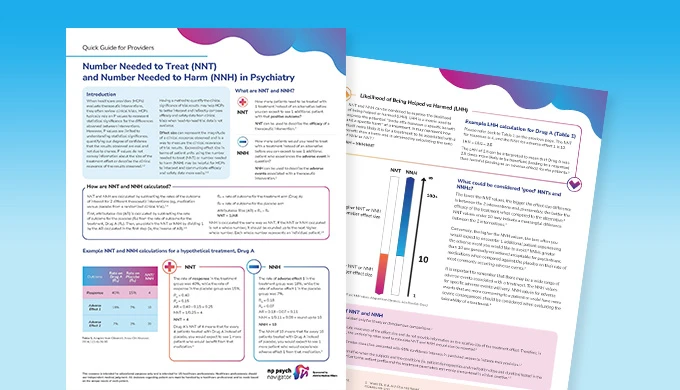
Number Needed to Treat (NNT) and Number Needed to Harm (NNH) in Psychiatry
Number needed to treat (NNT) and number needed to harm (NNH) are metrics that can be used to evaluate the clinical relevance of findings from clinical trials. Together, NNT and NNH can be used to express the likelihood of being helped or harmed (LHH), which may be helpful for communicating and understanding the potential benefits and risks of a treatment. This quick guide will review the definitions, calculations, and interpretations of NNT, NNH, and LHH. For additional information, please visit our Clinical Insights section for a video featuring Dr Leslie Citrome on this topic.
Quick Guides
Understanding Affective Switch in Bipolar I Disorder
Patients with bipolar I disorder (BP-1) may experience affective switch, which is a sudden transition in mood episodes between mania and depression. Affective switch can be triggered by certain medications as well as social or environmental factors. Learn how to recognize and monitor for signs of affective switch in patients with BP-1.
Quick Guides
Potential Pharmacological Impact on Dopamine and Serotonin Receptors
Dopamine and serotonin are known neurotransmitters in the brain. Learning the effects that these neurotransmitters may be associated with and how they can be modulated may help healthcare providers better understand their impact in psychiatry.
Quick Guides