
About Us
Learn more about NP Psych Navigator and our mission to help nurse practitioners improve mental healthcare.
New on NP Psych Navigator
Clinical Insights
Bipolar I Disorder Screening in Practice Video
This Clinical Insights video highlights the challenges in differentiating bipolar I disorder (BP-1) from major depressive disorder (MDD) and outlines how to use measurement-based care tools such as the Rapid Mood Screener to screen for BP-1 in patients previously diagnosed with MDD.
Quick Guides
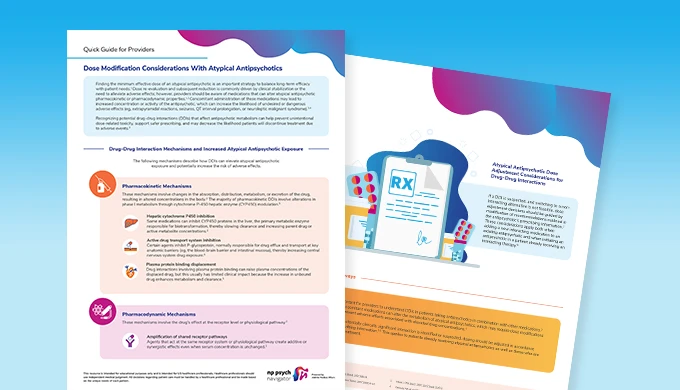
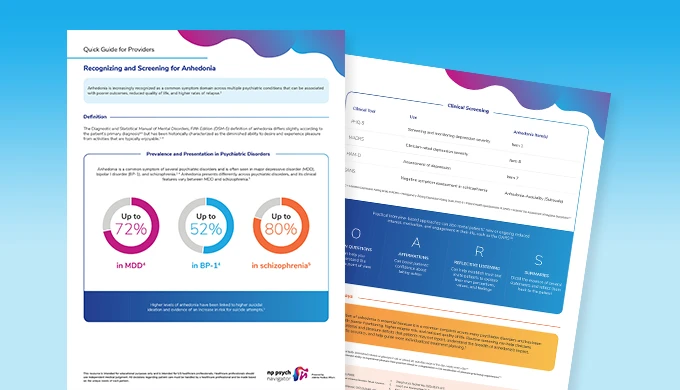
Partial Agonism: How Is It Thought to Work and What Is the Potential Clinical Relevance?
Understanding the neurotransmitter mechanisms thought to underlie the effects of medications used in treating mood disorders, including major depressive disorder (MDD), bipolar I disorder (BP-1), and schizophrenia, can help healthcare professionals make informed treatment decisions and manage patients’ symptoms.
Clinical Article
Treatment Patterns, Healthcare Resource Utilization, and Costs Associated With the Use of Atypical Antipsychotics as First vs Subsequent Adjunctive Treatment in Major Depressive Disorder
This retrospective study by Jain et al aimed to assess the use of atypical antipsychotics as first add-on treatment vs later add-on treatment in patients with MDD and to evaluate the potential impact of atypical antipsychotic line of therapy (LOT) on healthcare resource utilization (HCRU).
Recommended on NP Psych Navigator
Clinical Article
Treatment Patterns, Healthcare Resource Utilization, and Costs Associated With the Use of Atypical Antipsychotics as First vs Subsequent Adjunctive Treatment in Major Depressive Disorder
This retrospective study by Jain et al aimed to assess the use of atypical antipsychotics as first add-on treatment vs later add-on treatment in patients with MDD and to evaluate the potential impact of atypical antipsychotic line of therapy (LOT) on healthcare resource utilization (HCRU).
NP Perspectives
When it comes to giving the best care to your patients, experience matters. Check out our Clinical Insights to hear from our vibrant community of nurse practitioners.

Clinical Tools
Educate Your Patient
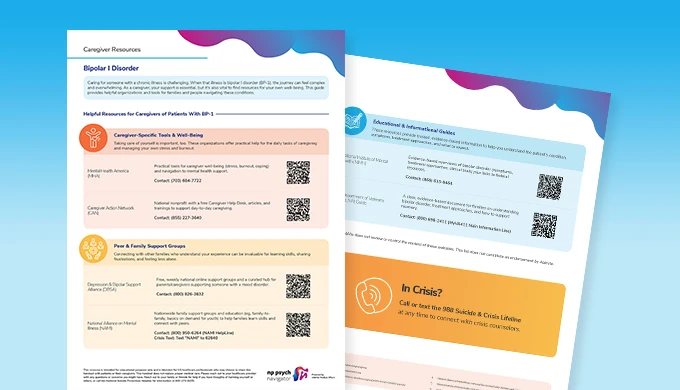
Bipolar I Disorder (BP-1) Treatment Goals: Symptom Remission and Functional Improvement
Living with bipolar I disorder (BP-1) can mean more than just managing symptoms; it’s about finding balance and working toward getting back to the activities and relationships that matter to you. This guide explores treatment goals that can help you and your care team work toward feeling better and functioning better in daily life. Setting clear goals and focusing on overall improvement can make a real difference in your recovery and long-term well-being.
Quick Guides
Treatment Patterns, Healthcare Resource Utilization, and Costs Associated With Use of Atypical Antipsychotics as First vs Subsequent Adjunctive Treatment in Major Depressive Disorder
Major depressive disorder (MDD) can be associated with substantial emotional, social, and economic burdens. Delaying appropriate treatment may contribute to negative outcomes and increased healthcare use. This quick guide highlights real-world data on the use of atypical antipsychotics as adjunctive therapy, with a focus on treatment patterns and healthcare resource impact in patients with MDD. These insights may help providers consider how treatment sequencing decisions could influence both patient care and system-level outcomes.
Quick Guides
Common Scales in Major Depressive Disorder and Bipolar I Disorder
Standardized psychiatric rating scales help healthcare providers gather critical information to support accurate diagnosis and management of mental health conditions, such as major depressive disorder (MDD) and bipolar I disorder (BP-1). When used alongside clinical assessment and patient input, these tools can help monitor treatment response over time and guide clinical decisions as part of measurement-based care.
Clinical Article
Burden of Misdiagnosis in Bipolar I Disorder
The results of a large, real-world study suggest that misdiagnosis of bipolar I disorder as major depressive disorder can be associated with significantly greater healthcare resource utilization and higher costs, particularly for mental health–related services, highlighting the importance of timely and accurate diagnosis.
Clinical Article
Real-World Treatment Patterns in Bipolar Disorder
The results of a large, real-world study by Jain et al suggest there may be an incongruence between current prescribing patterns and guideline recommendations for bipolar I disorder, with high use of antidepressants and benzodiazepines despite limited recommendations for these agents.
Test Your Knowledge
What to Consider When Prescribing Atypical Antipsychotics in Major Depressive Disorder
For patients with major depressive disorder (MDD) whose symptoms are not adequately managed with their initial antidepressant, adjunctive atypical antipsychotics can help. Take this quiz to test your knowledge on what providers should consider when prescribing atypical antipsychotics.
Test Your Knowledge
Predictors of Treatment-Emergent Affective Switch Quiz
Affective switch is a phenomenon that can occur in bipolar I disorder. In particular, affective switch can be triggered by certain medications in what is known as a treatment-emergent affective switch (TEAS), as well as by social and environmental factors. Test your knowledge of the potential symptoms and triggers of affective switch, including TEAS.
Psychiatry Fundamentals
Psychiatry draws upon skills that are essential to the nurse practitioner approach to patient care, empathy, compassion, and understanding. A thorough knowledge of the different mental illnesses complements those skills